Psychedelics for depression
Psilocybin, ayahuasca and DMT are being studied as treatments for depression, always with psychological support and within clinical trials. Psilocybin is the most advanced, with phase 3 trials in treatment-resistant depression; none of these substances is authorised as a medicine in the European Union.1,2,17

The storm moves off to the left and light returns to the river valley.
Thomas Cole, View from Mount Holyoke, Northampton, Massachusetts, after a Thunderstorm—The Oxbow, 1836. Oil on canvas. The Metropolitan Museum of Art, New York. Public domain. Artwork record (external site)
What is being studied?
Researchers are studying classic psychedelics, such as psilocybin and DMT, in prepared and supported sessions within a psychotherapy programme. These substances act mainly on the serotonin 5-HT2A receptor.21
In trials, each session is preceded by preparation and followed by integration sessions, and the person is supported throughout the effect.1,20 What is studied is the combination of substance and support, not the substance on its own.
What do psilocybin trials show?
In treatment-resistant depression, a phase 2 trial published in 2022 showed that a single dose of psilocybin, with psychological support, reduced symptoms at three weeks more than a control dose.1 Adverse effects were common and suicidal thoughts or behaviour occurred in all groups, which underlines the need for close clinical follow-up.1
Two phase 3 trials of a synthetic psilocybin formulation in treatment-resistant depression met their primary endpoint, according to company announcements in 2025 and 2026.2,3 As of October 2026, the application is being submitted to the FDA on a rolling basis, with completion expected by the end of 2026, and there is no approval yet.4 The FDA’s 2018 Breakthrough Therapy designation speeds up development but is not an approval.5
In major depression, randomised trials showed a reduction in symptoms compared with a waiting list and with an active placebo.6,7 In a trial against an SSRI antidepressant, there was no significant difference in the primary outcome.8 A phase 3 trial in major depression completed its main phase in 2026, with no results released yet.9
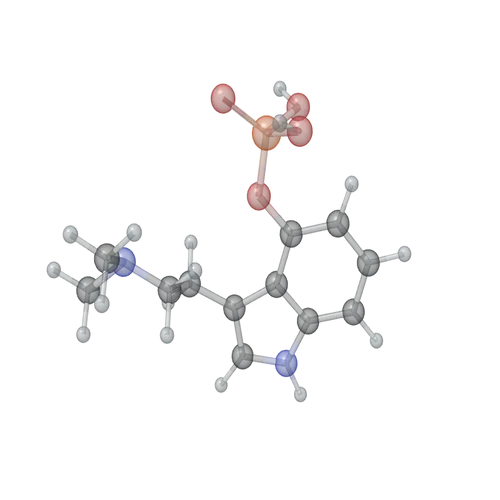
Psilocybin: in the body it is converted into psilocin, which acts mainly on the serotonin 5-HT2A receptor.21 The site’s model, also used on the psychedelic-assisted therapy page.
What about ayahuasca and DMT?
They are at an earlier stage. Ayahuasca is a traditional preparation that contains DMT and alkaloids that slow its breakdown in the body, which changes its profile of effects and interactions.21 In a small placebo-controlled trial in treatment-resistant depression, it had a rapid antidepressant effect, assessed over one week only.10
Short-acting intravenous DMT had positive results in a phase 2a trial in major depression,11 and an inhaled formulation of 5-MeO-DMT, a related molecule, in a phase 2b trial in treatment-resistant depression, both published in 2026.12
Ketamine and esketamine, which work through another mechanism, have a page of their own: Ketamine and esketamine in treatment-resistant depression.
At what stage is each substance?
The table distinguishes published trials, results announced by companies and regulatory submissions.
| Approach | Where it has been studied | Evidence | Stage |
|---|---|---|---|
| Psilocybin with psychological support | Treatment-resistant depression | Published phase 2 trial1; two positive phase 3 trials, according to the company2,3 | Phase 3 · US regulatory submission under way4 |
| Psilocybin with psychological support | Major depression | Positive randomised trials against a waiting list and an active placebo6,7; no difference in the primary outcome against an SSRI8 | Phase 2 · phase 3 results not yet released9 |
| Ayahuasca | Treatment-resistant depression | Small placebo-controlled trial, assessed over one week10 | Studied |
| Intravenous DMT | Major depression | Positive phase 2a trial (2026)11 | Phase 2 |
| Inhaled 5-MeO-DMT | Treatment-resistant depression | Positive phase 2b trial (2026)12 | Phase 2 |
| Ketamine and esketamine | Treatment-resistant depression | See the dedicated page | Esketamine approved in the EU · ketamine outside approved indications |
What are the limits of the evidence?
The main one is how hard it is to blind treatment. Because psychedelic effects are obvious, participants and staff often know who received the substance, and expectation can inflate the estimated effect.13,15 When the comparison uses the placebo response seen in antidepressant trials, the estimated effect of psilocybin becomes smaller.14
Trials have generally included carefully selected people, with short follow-up, and the phase 3 results known so far were announced by the company before scientific publication.2,3,13
What is assessed beforehand?
The personal and family psychiatric history is assessed: people with a history of psychosis or bipolar disorder are usually excluded from these trials.20 The following are also assessed:
- cardiovascular health, because classic psychedelics moderately raise blood pressure and pulse;20
- suicide risk, monitored throughout the trial;1
- other medication and substance use, including, for ayahuasca, the interactions of the alkaloids it contains;21
- the arrangements for preparation, support during the session and integration.20
Intense, transient anxiety may occur during the session; it is the most likely adverse reaction and is managed with preparation and support.20
What is the regulatory position?
In the European Union, no medicine containing psilocybin, MDMA, LSD or DMT is authorised; in Portugal, the clinical use of these substances is limited to clinical trials.17 The European Medicines Agency recognises the particular challenges of these trials and requires, as for any medicine, a positive benefit–risk balance.16
Other EU countries have exceptional, restricted routes: the Czech Republic has allowed restricted therapeutic use of psilocybin since 1 January 2026, and Germany has had a compassionate use programme in treatment-resistant depression since 2025.18 In Australia, since July 2023, authorised psychiatrists may prescribe psilocybin for treatment-resistant depression, although no registered medicine exists.16 In the United States, the FDA published final guidance on clinical trials with psychedelics in July 2026.19
What is still unknown?
- How much of the effect comes from the substance, from psychological support and from expectation.13,15
- How long the benefit lasts and when repeating a session makes sense.1
- Who benefits most, and who should be excluded, beyond the selected trial populations.13
- The full, peer-reviewed results of the phase 3 trials.2,3,9
What should I ask my psychiatrist?
- In my case, which approved treatments have not yet been tried?
- Is there a clinical trial under way for which I might be eligible?
- Does my personal or family history rule out these approaches?
- How can I tell a clinical trial from an offer without a proper framework?
- What support is there before, during and after?
In summary
- Psilocybin is the most studied psychedelic in depression, with positive phase 3 trials in treatment-resistant depression, according to the company, and an FDA submission under way.
- Ayahuasca, DMT and 5-MeO-DMT have small or phase 2 trials.
- The difficulty of blinding treatment, and expectation, limit how results can be interpreted.
- None of these substances is authorised as a medicine in the European Union; in Portugal, clinical use is limited to clinical trials.
- The prior assessment usually excludes people with a history of psychosis or bipolar disorder.
References
- Goodwin GM, Aaronson ST, Alvarez O, et al. Single-dose psilocybin for a treatment-resistant episode of major depression. N Engl J Med. 2022;387(18):1637–1648. doi:10.1056/NEJMoa2206443 PubMed (external site)
- COMPASS Pathways. Press release of 23 June 2025: first phase 3 trial of psilocybin in treatment-resistant depression meets its primary endpoint. Source (external site)
- COMPASS Pathways. Press release of 17 February 2026: second phase 3 trial of psilocybin in treatment-resistant depression meets its primary endpoint. Source (external site)
- COMPASS Pathways. Second-quarter 2026 results (5 August 2026; Form 8-K, SEC): rolling submission to the FDA under way, expected to be completed in the fourth quarter of 2026. Source (external site)
- COMPASS Pathways. Press release of 23 October 2018: FDA Breakthrough Therapy designation for psilocybin in treatment-resistant depression. Source (external site)
- Davis AK, Barrett FS, May DG, et al. Effects of psilocybin-assisted therapy on major depressive disorder: a randomized clinical trial. JAMA Psychiatry. 2021;78(5):481–489. doi:10.1001/jamapsychiatry.2020.3285 PubMed (external site)
- Raison CL, Sanacora G, Woolley J, et al. Single-dose psilocybin treatment for major depressive disorder: a randomized clinical trial. JAMA. 2023;330(9):843–853. doi:10.1001/jama.2023.14530 PubMed (external site)
- Carhart-Harris R, Giribaldi B, Watts R, et al. Trial of psilocybin compared with an SSRI antidepressant for depression. N Engl J Med. 2021;384(15):1402–1411. doi:10.1056/NEJMoa2032994 PubMed (external site)
- ClinicalTrials.gov. NCT06308653: phase 3 trial of psilocybin in major depressive disorder (record updated 23 July 2026). Source (external site)
- Palhano-Fontes F, Barreto D, Onias H, et al. Rapid antidepressant effects of the psychedelic ayahuasca in treatment-resistant depression: a randomized placebo-controlled trial. Psychol Med. 2019;49(4):655–663. doi:10.1017/S0033291718001356 PubMed (external site)
- Erritzoe D, Barba T, Benway T, et al. A short-acting psychedelic intervention for major depressive disorder: a phase IIa randomized placebo-controlled trial. Nat Med. 2026;32(2):591–598. doi:10.1038/s41591-025-04154-z PubMed (external site)
- Cubała WJ, Bajbouj M, Bauer M, et al. Randomised trial of inhaled 5-MeO-DMT versus placebo in treatment-resistant depression. JAMA Psychiatry. 2026;83(6):561–569. doi:10.1001/jamapsychiatry.2026.0096 PubMed (external site)
- Metaxa AM, Clarke M. Efficacy of psilocybin for treating symptoms of depression: systematic review and meta-analysis. BMJ. 2024;385:e078084. doi:10.1136/bmj-2023-078084 PubMed (external site)
- Hsu TW, Tsai CK, Kao YC, et al. Systematic review and Bayesian network meta-analysis of oral monotherapy with psychedelics and with an SSRI antidepressant for depressive symptoms. BMJ. 2024;386:e078607. doi:10.1136/bmj-2023-078607 PubMed (external site)
- Muthukumaraswamy SD. Overcoming blinding confounds in psychedelic randomized controlled trials using biomarker driven causal mediation analysis. Expert Rev Clin Pharmacol. 2023;16(12):1163–1173. doi:10.1080/17512433.2023.2279736 PubMed (external site)
- European Medicines Agency. EMA multi-stakeholder workshop on psychedelics: workshop report. 2024 (includes the Australian framework since 1 July 2023). Source (external site)
- European Medicines Agency, medicines register (accessed 10 October 2026): no marketing authorisation for psilocybin, MDMA, LSD or DMT; European Medicines Agency, report of the multi-stakeholder workshop on psychedelics (2024). Source (external site)
- Czech Republic, Act No. 270/2025 Coll., in force since 1 January 2026 (psilocybin for restricted therapeutic use); Germany, compassionate use programme for psilocybin in treatment-resistant depression, Central Institute of Mental Health, Mannheim (press release of 31 July 2025). Source (external site)
- U.S. Food and Drug Administration. Psychedelic drugs: considerations for clinical investigations, final guidance. Federal Register, 14 July 2026. Source (external site)
- Johnson M, Richards W, Griffiths R. Human hallucinogen research: guidelines for safety. J Psychopharmacol. 2008;22(6):603–620. doi:10.1177/0269881108093587 PubMed (external site)
- Nichols DE. Psychedelics. Pharmacol Rev. 2016;68(2):264–355. doi:10.1124/pr.115.011478 PubMed (external site)
Clinical review: Pedro Zuzarte, psychiatrist · Published: · Reviewed: .