Ketamine and esketamine in treatment-resistant depression
Ketamine is an anaesthetic that, in clinical trials, has shown a rapid antidepressant effect in treatment-resistant depression. Esketamine is one of the two forms of the same molecule; as a nasal spray, it is approved in the European Union for treatment-resistant depression, together with an antidepressant and under clinical supervision.1,2
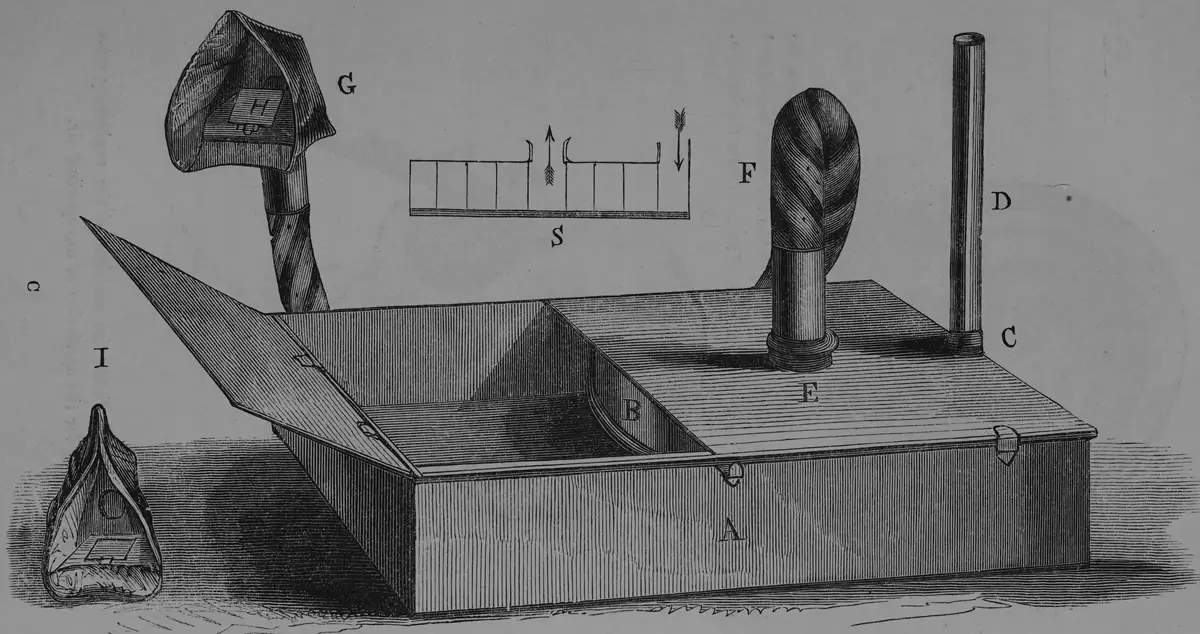
One of the first devices designed to give an anaesthetic in a regulated way. Ketamine began, a century later, as an anaesthetic.
John Snow, ether inhaler, in On the Inhalation of the Vapour of Ether in Surgical Operations, London, 1847, p. 17. Engraving. Wellcome Collection. Public domain. Artwork record (external site)
What is ketamine?
Ketamine is an injectable general anaesthetic, used to induce and maintain anaesthesia, for procedural sedation and for pain relief; it has been on the World Health Organization Model List of Essential Medicines since 1984.3
It acts mainly by blocking the NMDA receptor, one of the receptors for glutamate, the brain’s main excitatory messenger.1 The molecule exists in two mirror-image forms; the ketamine used in anaesthesia is a racemic mixture of both, esketamine and arketamine.1

The human NMDA receptor, with esketamine bound in the ion channel, seen by cryo-electron microscopy.20
Human NMDA receptor bound to esketamine (PDB 7EU7; Zhang et al., Nature, 2021). Image: RCSB PDB. CC0. Structure record (external site)
What is esketamine?
Esketamine is the S form of the ketamine molecule, used on its own. Like ketamine, it is a non-competitive NMDA receptor antagonist.1
As a nasal spray, it has held an authorisation valid throughout the European Union since 18 December 2019, for adults with treatment-resistant depression and no response to two or more different antidepressants during the current moderate or severe episode, always together with an SSRI or SNRI antidepressant.1,2 Since February 2021, the authorisation also covers short-term treatment, with an oral antidepressant, to rapidly reduce depressive symptoms that, in clinical judgement, constitute a psychiatric emergency.4
The conditions of use are part of the authorisation. The decision to prescribe rests with a psychiatrist; the spray is self-administered in an appropriate clinical setting under the direct supervision of a healthcare professional; blood pressure is measured before and about 40 minutes after; and the person stays under observation until clinically stable.1
What does the research show?
It shows a rapid antidepressant effect. The first controlled trial, published in 2000, recorded improvement within 72 hours of a ketamine infusion compared with placebo.5 In 2006, a trial in treatment-resistant depression confirmed an effect starting within hours and lasting about a week.6
Esketamine nasal spray was assessed in phase 3 trials. Added to a newly started oral antidepressant, it was superior to the antidepressant with a placebo spray;7 continued in people who had responded, it delayed relapse.8 In a 2023 trial, it led to more remissions at eight weeks than augmentation with an atypical antipsychotic.9
Also in 2023, in a randomised trial in treatment-resistant depression without psychosis, intravenous ketamine was non-inferior to electroconvulsive therapy.10 An international expert consensus regards ketamine and esketamine as the first non-monoaminergic agents with proven rapid-onset efficacy in depression, with questions still open about their place in treatment algorithms and the conditions for giving them.11 An earlier consensus from the American Psychiatric Association stressed the limits of the data and the need for caution.18
At what stage is each approach?
The table separates what is approved from what has been studied with positive results and what is still under investigation.
| Approach | Where it has been studied | Evidence | Stage |
|---|---|---|---|
| Intravenous ketamine, single dose | Major depression and treatment-resistant depression | Placebo-controlled trials: rapid, transient effect5,6 | Positive trial · outside approved indications |
| Intravenous ketamine compared with ECT | Treatment-resistant depression without psychosis | Non-inferior to ECT (2023)10 | Positive trial · outside approved indications |
| Esketamine nasal spray with an antidepressant | Treatment-resistant depression | Acute efficacy and relapse prevention7,8 | Phase 3 · approved in the EU (2019) |
| Esketamine compared with atypical antipsychotic augmentation | Treatment-resistant depression | More remissions at week 89 | Phase 3b · approved in the EU |
| Esketamine in a psychiatric emergency, with an oral antidepressant | Moderate to severe depressive episode | Extension of indication approved by the European Commission4 | Approved in the EU (2021) |
| Ketamine-assisted psychotherapy | Depression; alcohol use disorder | Narrative review and uncontrolled case series; phase 2 trial in alcohol use12,13,14 | Investigational |
What is ketamine-assisted therapy?
It is a research model that combines ketamine with structured psychotherapy in three stages: preparation, before the session; the session itself, with support; and integration, afterwards, to work through what came up.12
A systematic review suggests that psychotherapy before, during and after the sessions may prolong the benefits, with wide variation between studies; the authors call for larger randomised trials.12 The remaining data come from case series without a control group13 and from a phase 2 trial in alcohol use disorder, in which ketamine with psychological therapy was followed by more days of abstinence at six months.14 In depression, this model is still under investigation.
What safety monitoring does it need?
It needs a prior assessment and monitoring at every administration. The most typical effects occur on the day itself and are transient: dissociation, a sense of distance from one’s body or surroundings that usually passes in about an hour and a half, and a temporary rise in blood pressure, peaking about 40 minutes later.1
Before starting, the following are assessed:
- cardiovascular and cerebrovascular disease: esketamine is contraindicated in people with aneurysmal vascular disease, a history of intracerebral haemorrhage, or a cardiovascular event in the last six weeks, including myocardial infarction;1
- blood pressure, measured before and after each administration;1
- the risk of abuse or misuse, assessed beforehand and monitored during treatment; dependence and tolerance have been reported with prolonged ketamine use;1
- urinary symptoms: chronic recreational ketamine use is associated with bladder toxicity, and monitoring is recommended during longer treatment;1,15,16
- other medication, to identify relevant interactions.
On the day of treatment, driving or operating machinery should wait until the next day, after a restful night’s sleep.1 Esketamine has not been shown to prevent suicide or reduce suicidal thoughts, and it does not replace hospital admission when admission is indicated.1
What is the position in Portugal?
In Portugal, Infarmed approved public funding of esketamine nasal spray in May 2025 for hospital use in the national health service, for a narrower group than the European authorisation covers: adults with no response to at least three antidepressants, including combination or augmentation strategies, with prior psychotherapy, and for whom electroconvulsive therapy has not worked, is contraindicated, is not accessible or has been declined.17
Ketamine is authorised as an anaesthetic, and its use in depression is outside the approved indications (“off-label”).3,18 Off-label use means prescribing an authorised medicine for a situation not included in its summary of product characteristics. It is an individual clinical decision, made with informed consent, and it may not be advertised.19
In Portugal, the Psychiatry Specialty College of the Portuguese Medical Association published a resolution on the clinical use of these substances in 2023 (CEP-2023-R-02).
What should I ask my psychiatrist?
- Were previous treatments given at an adequate dose and for long enough?
- What other options are there in my case, such as transcranial magnetic stimulation or electroconvulsive therapy?
- Do I have any condition that rules out esketamine?
- Where and how would treatment take place, and how do I get home that day?
- What effects should I expect on the day itself?
- How is the response measured, and when is the decision made to continue or stop?
What is still unknown?
- The exact place of ketamine and esketamine in treatment algorithms and how they compare directly with other options.11
- The ideal conditions for giving them: setting, infrastructure and staff.11
- The long-term effects of repeated treatment, including on the bladder.15
- The contribution of accompanying psychotherapy, which needs larger randomised trials.12
In summary
- Ketamine is an authorised anaesthetic; in depression, its use is outside the approved indications.
- Esketamine nasal spray has been approved in the EU since 2019 for treatment-resistant depression, with an SSRI or SNRI and under supervision.
- Trials show a rapid antidepressant effect; esketamine has positive phase 3 trials.
- Treatment needs a cardiovascular assessment, blood pressure monitoring and attention to the risk of abuse and to urinary symptoms.
- Ketamine-assisted therapy remains under investigation in depression.
References
- European Medicines Agency. Esketamine nasal spray: summary of product characteristics (sections 4.1 to 5.1). Source (external site)
- European Medicines Agency. Esketamine nasal spray: European public assessment report (EPAR, EMEA/H/C/004535); marketing authorisation valid throughout the EU since 18 December 2019. Source (external site)
- World Health Organization. Electronic Essential Medicines List: ketamine (injectable general anaesthetic; on the list since 1984). Source (external site)
- European Medicines Agency. Esketamine nasal spray: procedural steps taken after authorisation (extension of indication, European Commission decision of 4 February 2021). Source (external site)
- Berman RM, Cappiello A, Anand A, et al. Antidepressant effects of ketamine in depressed patients. Biol Psychiatry. 2000;47(4):351–354. doi:10.1016/s0006-3223(99)00230-9 PubMed (external site)
- Zarate CA Jr, Singh JB, Carlson PJ, et al. A randomized trial of an N-methyl-D-aspartate antagonist in treatment-resistant major depression. Arch Gen Psychiatry. 2006;63(8):856–864. doi:10.1001/archpsyc.63.8.856 PubMed (external site)
- Popova V, Daly EJ, Trivedi M, et al. Efficacy and safety of flexibly dosed esketamine nasal spray combined with a newly initiated oral antidepressant in treatment-resistant depression: a randomized double-blind active-controlled study. Am J Psychiatry. 2019;176(6):428–438. doi:10.1176/appi.ajp.2019.19020172 PubMed (external site)
- Daly EJ, Trivedi MH, Janik A, et al. Efficacy of esketamine nasal spray plus oral antidepressant treatment for relapse prevention in patients with treatment-resistant depression: a randomized clinical trial. JAMA Psychiatry. 2019;76(9):893–903. doi:10.1001/jamapsychiatry.2019.1189 PubMed (external site)
- Reif A, Bitter I, Buyze J, et al.; ESCAPE-TRD Investigators. Randomised trial of esketamine nasal spray versus atypical antipsychotic augmentation in treatment-resistant depression. N Engl J Med. 2023;389(14):1298–1309. doi:10.1056/NEJMoa2304145 PubMed (external site)
- Anand A, Mathew SJ, Sanacora G, et al. Ketamine versus ECT for nonpsychotic treatment-resistant major depression. N Engl J Med. 2023;388(25):2315–2325. doi:10.1056/NEJMoa2302399 PubMed (external site)
- McIntyre RS, Rosenblat JD, Nemeroff CB, et al. Synthesizing the evidence for ketamine and esketamine in treatment-resistant depression: an international expert opinion on the available evidence and implementation. Am J Psychiatry. 2021;178(5):383–399. doi:10.1176/appi.ajp.2020.20081251 PubMed (external site)
- Drozdz SJ, Goel A, McGarr MW, et al. Ketamine assisted psychotherapy: a systematic narrative review of the literature. J Pain Res. 2022;15:1691–1706. doi:10.2147/JPR.S360733 PubMed (external site)
- Dore J, Turnipseed B, Dwyer S, et al. Ketamine assisted psychotherapy (KAP): patient demographics, clinical data and outcomes in three large practices administering ketamine with psychotherapy. J Psychoactive Drugs. 2019;51(2):189–198. doi:10.1080/02791072.2019.1587556 PubMed (external site)
- Grabski M, McAndrew A, Lawn W, et al. Adjunctive ketamine with relapse prevention-based psychological therapy in the treatment of alcohol use disorder. Am J Psychiatry. 2022;179(2):152–162. doi:10.1176/appi.ajp.2021.21030277 PubMed (external site)
- Kerr-Gaffney J, Tröger A, Caulfield A, Ritter P, Rucker J, Young AH. Urological symptoms following ketamine treatment for psychiatric disorders: a systematic review. J Psychopharmacol. 2025;39(10):1103–1113. doi:10.1177/02698811251350267 PubMed (external site)
- Lam RW, Kennedy SH, Adams C, et al. Canadian Network for Mood and Anxiety Treatments (CANMAT) 2023 update on clinical guidelines for management of major depressive disorder in adults. Can J Psychiatry. 2024;69(9):641–687. doi:10.1177/07067437241245384 PMC (external site)
- Infarmed (Portuguese medicines authority). Public funding assessment report: esketamine (nasal spray) in treatment-resistant depression. Approval decision of 7 May 2025; report of 12 May 2025. Source (external site)
- Sanacora G, Frye MA, McDonald W, et al. A consensus statement on the use of ketamine in the treatment of mood disorders. JAMA Psychiatry. 2017;74(4):399–405. doi:10.1001/jamapsychiatry.2017.0080 PubMed (external site)
- Directive 2001/83/EC of the European Parliament and of the Council on the Community code relating to medicinal products for human use, Article 87(2) (all parts of the advertising of a medicinal product must comply with its summary of product characteristics). Source (external site)
- Zhang Y, Ye F, Zhang T, et al. Structural basis of ketamine action on human NMDA receptors. Nature. 2021;596:301–305. doi:10.1038/s41586-021-03769-9 (PDB structure 7EU7). Source (external site)
Clinical review: Pedro Zuzarte, psychiatrist · Published: · Reviewed: .