Psychedelics for anxiety
LSD and psilocybin are being studied as treatments for anxiety: LSD mainly in generalised anxiety disorder, psilocybin for anxiety linked to serious illnesses such as cancer. The first phase 3 results with LSD were announced in 2026, and no psychedelic is approved for anxiety disorders in the United States or the European Union.4,5,13
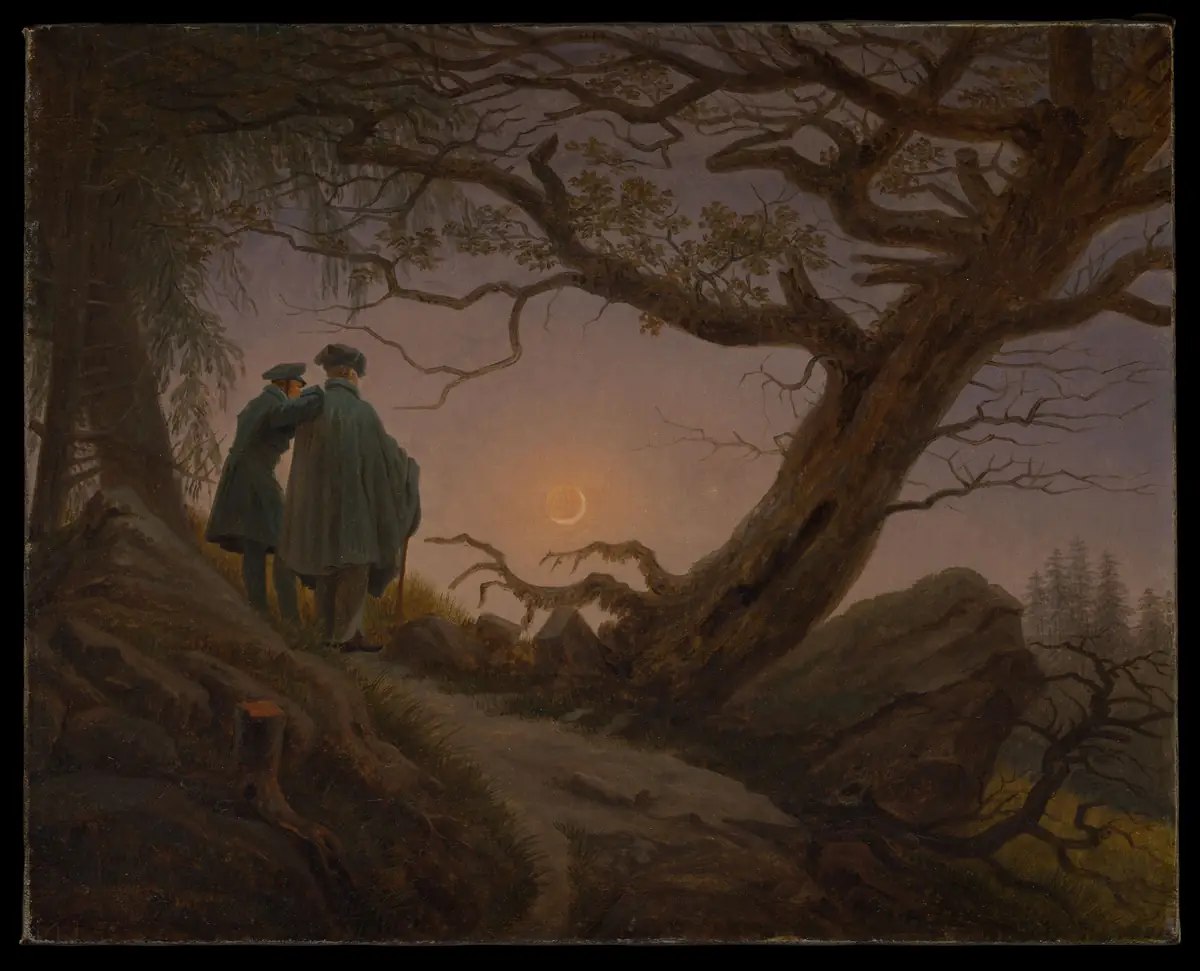
Two figures pause on the path to look at the moon in silence.
Caspar David Friedrich, Two Men Contemplating the Moon, c. 1825–30. Oil on canvas. The Metropolitan Museum of Art, New York. Public domain. Artwork record (external site)
Which kinds of anxiety are being studied?
Two different situations. In generalised anxiety disorder, a persistent worry that is hard to control, research focuses on a pharmaceutical formulation of LSD given as a single dose.3 In anxiety linked to life-threatening illnesses, such as advanced cancer, psilocybin and LSD are studied, always with psychotherapy.1,8,9
Both are classic psychedelics and act mainly on the serotonin 5-HT2A receptor; the structure of this receptor with LSD bound was determined in 2020.15 Anxiety, its symptoms and usual treatments are described on the Anxiety page.
What do LSD studies show?
They show reductions in anxiety in phase 2 trials and, in 2026, the first phase 3 results. A small Swiss study in 2014 suggested that LSD-assisted psychotherapy may reduce anxiety linked to life-threatening illness.1 A Swiss phase 2 trial, published in 2023, showed lasting reductions in anxiety in people with and without serious illness.2
In generalised anxiety disorder, a pharmaceutical formulation of LSD reduced anxiety in a phase 2b trial published in 2025, with a dose-dependent effect.3 In August and September 2026, the company announced that two phase 3 trials met their primary endpoint; the data have not yet been published in a peer-reviewed journal.4,5 The FDA application is expected in the first half of 2027.5 The FDA’s 2024 Breakthrough Therapy designation speeds up development but is not an approval.6

The serotonin 5-HT2A receptor, the main target of classic psychedelics, with LSD bound, determined by crystallography.15
Human 5-HT2A receptor (PDB 6WGT; Kim et al., Cell, 2020). Image: RCSB PDB. CC0. Structure record (external site)
What about psilocybin?
It has been studied mainly for anxiety and depression linked to cancer. A 2011 pilot study and two randomised trials in 2016 showed rapid and lasting reductions after a single psilocybin session with psychotherapy.7,8,9 In a follow-up of several years, some participants kept their reduction in anxiety, depression and fear of death; that follow-up had no control group.10
At what stage is each approach?
The table distinguishes pilot studies, phase 2 trials and phase 3 results announced by the company.
| Approach | Where it has been studied | Evidence | Stage |
|---|---|---|---|
| LSD with psychotherapy | Anxiety associated with life-threatening illness | Pilot study (2014)1 | Studied |
| LSD with psychotherapy | Anxiety, with and without serious illness | Positive phase 2 trial (2023)2 | Phase 2 |
| LSD formulation, single dose | Generalised anxiety disorder | Positive, dose-dependent phase 2b trial (2025)3 | Phase 2 |
| LSD formulation, single dose | Generalised anxiety disorder | Two positive phase 3 trials, according to the company (2026)4,5 | Phase 3 · FDA application expected in 2027 |
| Psilocybin with psychotherapy | Anxiety and depression associated with cancer | Small randomised trials (2011, 2016) and uncontrolled follow-up7,8,9,10 | Phase 2 |
What is assessed beforehand?
The personal and family psychiatric history is assessed: people with a history of psychosis or of other serious psychiatric disorders, such as bipolar disorder, are usually excluded.11 The following are also assessed:
- cardiovascular health, because classic psychedelics moderately raise blood pressure and pulse; hypertension is usually an exclusion criterion in trials;11
- other medication and substance use;
- the arrangements for preparation, setting and support during the session.11
Intense, transient anxiety may occur during the session; it is the most likely adverse reaction to classic psychedelics and is managed with preparation and support.11 In the LSD trials, the most common adverse effects were visual perceptual changes, nausea and headache.3
What is the regulatory position?
No psychedelic medicine is approved for anxiety disorders in the United States or the European Union.5,13 In Portugal, the clinical use of these substances is limited to clinical trials.13 In Australia, the exceptional access created in July 2023 covers only psilocybin for treatment-resistant depression and MDMA for post-traumatic stress disorder, and does not include anxiety disorders.12 Other EU countries have exceptional, restricted routes focused on depression.14
What is still unknown?
What should I ask my psychiatrist?
- Has my anxiety been assessed, including medical causes and other associated disorders?
- Which treatments with proven efficacy have I not yet tried?
- Does my personal or family history rule out these approaches?
- Are there clinical trials under way for which I might be eligible?
In summary
- LSD and psilocybin are being studied for anxiety, always with psychological support.
- In generalised anxiety disorder, an LSD formulation had positive phase 3 trials in 2026, according to the company, not yet published after peer review.
- Psilocybin reduced anxiety linked to cancer in small trials.
- No psychedelic is approved for anxiety disorders in the United States or the European Union.
- The prior assessment usually excludes people with a history of psychosis or bipolar disorder and considers cardiovascular health.
References
- Gasser P, Holstein D, Michel Y, et al. Safety and efficacy of lysergic acid diethylamide-assisted psychotherapy for anxiety associated with life-threatening diseases. J Nerv Ment Dis. 2014;202(7):513–520. doi:10.1097/NMD.0000000000000113 PubMed (external site)
- Holze F, Gasser P, Müller F, Dolder PC, Liechti ME. Lysergic acid diethylamide-assisted therapy in patients with anxiety with and without a life-threatening illness: a randomized, double-blind, placebo-controlled phase II study. Biol Psychiatry. 2023;93(3):215–223. doi:10.1016/j.biopsych.2022.08.025 PubMed (external site)
- Robison R, Barrow R, Conant C, et al. Randomised clinical trial of a single dose of an LSD formulation in generalised anxiety disorder. JAMA. 2025;334(15):1358–1372. doi:10.1001/jama.2025.13481 PubMed (external site)
- Definium Therapeutics (formerly MindMed). Press release of 12 August 2026: positive topline results from the first phase 3 trial of an LSD formulation in generalised anxiety disorder. Source (external site)
- Definium Therapeutics. Press release of 14 September 2026: positive topline results from the second phase 3 trial; FDA application expected in the first half of 2027. Source (external site)
- Definium Therapeutics, Inc. Quarterly report (Form 10-Q, SEC), quarter ended 31 March 2026: change of name and Breakthrough Therapy designation in generalised anxiety disorder (2024). Source (external site)
- Grob CS, Danforth AL, Chopra GS, et al. Pilot study of psilocybin treatment for anxiety in patients with advanced-stage cancer. Arch Gen Psychiatry. 2011;68(1):71–78. doi:10.1001/archgenpsychiatry.2010.116 PubMed (external site)
- Griffiths RR, Johnson MW, Carducci MA, et al. Psilocybin produces substantial and sustained decreases in depression and anxiety in patients with life-threatening cancer: a randomized double-blind trial. J Psychopharmacol. 2016;30(12):1181–1197. doi:10.1177/0269881116675513 PubMed (external site)
- Ross S, Bossis A, Guss J, et al. Rapid and sustained symptom reduction following psilocybin treatment for anxiety and depression in patients with life-threatening cancer: a randomized controlled trial. J Psychopharmacol. 2016;30(12):1165–1180. doi:10.1177/0269881116675512 PubMed (external site)
- Agin-Liebes GI, Malone T, Yalch MM, et al. Long-term follow-up of psilocybin-assisted psychotherapy for psychiatric and existential distress in patients with life-threatening cancer. J Psychopharmacol. 2020;34(2):155–166. doi:10.1177/0269881119897615 PubMed (external site)
- Johnson M, Richards W, Griffiths R. Human hallucinogen research: guidelines for safety. J Psychopharmacol. 2008;22(6):603–620. doi:10.1177/0269881108093587 PubMed (external site)
- Nutt DJ, Hunt P, Schlag AK, Fitzgerald P. The Australia story: current status and future challenges for the clinical applications of psychedelics. Br J Pharmacol. 2026;183(14):4048–4057. doi:10.1111/bph.17398 PubMed (external site)
- European Medicines Agency, medicines register (accessed 10 October 2026): no marketing authorisation for psilocybin, MDMA, LSD or DMT; European Medicines Agency, report of the multi-stakeholder workshop on psychedelics (2024). Source (external site)
- Czech Republic, Act No. 270/2025 Coll., in force since 1 January 2026 (psilocybin for restricted therapeutic use); Germany, compassionate use programme for psilocybin in treatment-resistant depression, Central Institute of Mental Health, Mannheim (press release of 31 July 2025). Source (external site)
- Kim K, Che T, Panova O, et al. Structure of a hallucinogen-activated Gq-coupled 5-HT2A serotonin receptor. Cell. 2020;182(6):1574–1588. doi:10.1016/j.cell.2020.08.024 (PDB structure 6WGT). Source (external site)
Clinical review: Pedro Zuzarte, psychiatrist · Published: · Reviewed: .