MDMA and post-traumatic stress disorder
MDMA has been studied as an adjunct to psychotherapy for post-traumatic stress disorder (PTSD), in two phase 3 trials with positive results.1,2 In 2024, the FDA did not approve it and asked for another trial; in the European Union it is not an authorised medicine, and trauma-focused psychotherapy remains the first-line treatment.5,11,16

Painted in the year the American Civil War ended: a former soldier back at work in the fields.
Winslow Homer, The Veteran in a New Field, 1865. Oil on canvas. The Metropolitan Museum of Art, New York. Public domain. Artwork record (external site)
What is MDMA-assisted therapy?
It is a psychotherapy programme in which some sessions take place under the effect of MDMA, with preparation beforehand and integration sessions afterwards.1 In the trials, MDMA was always given within this programme, never on its own, and the comparison was with the same psychotherapy plus placebo.1,2
Post-traumatic stress disorder has a page of its own, covering symptoms, assessment and usual treatments: Post-traumatic stress disorder.
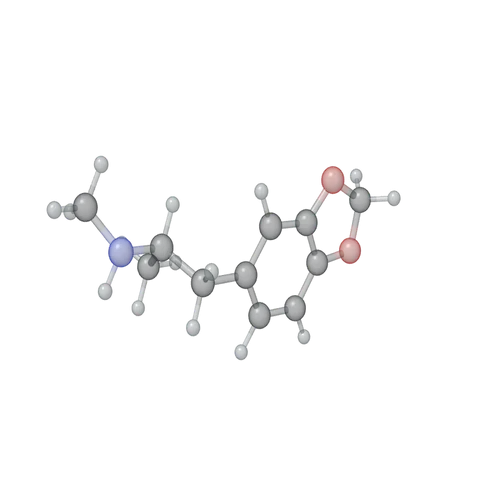
MDMA (3,4-methylenedioxymethamphetamine). The site’s model, also used on the psychedelic-assisted therapy page.
What did the phase 3 trials show?
They showed a greater reduction in symptoms with MDMA than with placebo, in both cases with the same psychotherapy. The first trial, published in 2021, included people with severe PTSD;1 the second, published in 2023, people with moderate to severe PTSD.2
In 2024, a scientific journal retracted three papers based on pooled analyses of the phase 2 trials, because of protocol violations amounting to unethical conduct at one site. The phase 3 trial papers were not retracted.6
Why did the FDA not approve it?
It judged the evidence insufficient for approval. In June 2024, an FDA advisory committee voted by a majority against demonstrated efficacy and against a favourable benefit–risk balance.4 The FDA stressed that MDMA’s effects make it almost impossible to blind treatment, which can introduce expectation bias, and noted that adverse effects linked to abuse potential had not been collected systematically.3
In August 2024, the FDA did not approve the application and asked for an additional phase 3 trial.5 The same year, an independent US report found the public evidence insufficient to judge benefits and harms, pointing to functional unblinding and concerns about how the trials were designed and conducted.7
What changed in 2026?
On 9 August 2026, the specialist publication Psychedelic Alpha reported that the company developing MDMA, now Resilient Pharmaceuticals (formerly Lykos Therapeutics), had filed its application with the FDA again without running another phase 3 trial.8 The next day, 10 August, MAPS, which founded the company, reacted to the report.9 The report relied on unnamed sources: the company has not confirmed it publicly and, so far, the FDA has not announced a decision.8,9
In July 2026, the FDA published final guidance on how to conduct clinical trials with psychedelics, including the question of blinding.10
At what stage is each approach?
The table places MDMA alongside usual treatment, to show where each one stands.
| Approach | Where it has been studied | Evidence | Stage |
|---|---|---|---|
| Trauma-focused psychotherapies | Post-traumatic stress disorder | International guidelines: first-line treatment11,12 | Approved · available |
| MDMA with psychotherapy | Severe post-traumatic stress disorder | Positive phase 3 trial (2021)1 | Phase 3 |
| MDMA with psychotherapy | Moderate to severe post-traumatic stress disorder | Positive phase 3 trial (2023)2 | Phase 3 |
| US marketing application | — | Not approved in 2024; another phase 3 trial requested5 | Regulatory submission (2024) |
| New US submission | — | Reported on 9 August 2026, not publicly confirmed by the company8,9 | No FDA decision |
| Exceptional access in Australia | Post-traumatic stress disorder | Prescribing by authorised psychiatrists since July 202315 | Legal (restricted access) |
What is the first-line treatment?
What are the risks of MDMA?
The most relevant risks are cardiovascular. In controlled studies in healthy volunteers, MDMA raised blood pressure, heart rate and body temperature in a relevant proportion of people, and the risk is likely to be higher in people with heart disease.13 Other known risks:
- hyponatraemia, a dangerous fall in blood sodium, especially with excessive water intake;14
- a rise in body temperature;13
- abuse potential, which the FDA considered similar to that of other controlled stimulants.3
For this reason, in the trials, the prior assessment covered cardiovascular health, current medication and psychiatric history, with monitoring during sessions.1,3
What is the position in Portugal and elsewhere?
In the European Union, MDMA is not an authorised medicine; in Portugal, its clinical use is limited to clinical trials.16 Australia has allowed specifically authorised psychiatrists to prescribe MDMA for post-traumatic stress disorder since July 2023, even though no registered medicine exists.15 In the United States it is not approved.5,8
What is still unknown?
What should I ask my psychiatrist?
- Have I completed a full course of trauma-focused psychotherapy with a specifically trained therapist?
- Are there other conditions, such as depression, substance use or sleep problems, that should be treated at the same time?
- Would my cardiovascular health allow me to take part in a clinical trial?
- Are there clinical trials under way for which I might be eligible?
In summary
- MDMA has been studied as an adjunct to psychotherapy for PTSD, with two positive phase 3 trials.
- In 2024, the FDA did not approve it, citing the difficulty of blinding treatment, and asked for another trial.
- In 2026, a new submission was reported, without public confirmation from the company and without an FDA decision.
- It is not an authorised medicine in the European Union; Australia has had restricted access since 2023.
- Trauma-focused psychotherapy remains the first-line treatment.
References
- Mitchell JM, Bogenschutz M, Lilienstein A, et al. MDMA-assisted therapy for severe PTSD: a randomized, double-blind, placebo-controlled phase 3 study. Nat Med. 2021;27(6):1025–1033. doi:10.1038/s41591-021-01336-3 PubMed (external site)
- Mitchell JM, Ot’alora G M, van der Kolk B, et al. MDMA-assisted therapy for moderate to severe PTSD: a randomized, placebo-controlled phase 3 trial. Nat Med. 2023;29(10):2473–2480. doi:10.1038/s41591-023-02565-4 PubMed (external site)
- U.S. Food and Drug Administration, Division of Psychiatry. Psychopharmacologic Drugs Advisory Committee, 4 June 2024: presentation on the MDMA application for post-traumatic stress disorder (NDA 215455). Source (external site)
- PharmExec. FDA advisory committee vote on MDMA for post-traumatic stress disorder (5 June 2024). Source (external site)
- Lykos Therapeutics. Announcement of the FDA complete response letter on the MDMA application for post-traumatic stress disorder. 9 August 2024. Source (external site)
- Retraction Note: Long-term follow-up outcomes of MDMA-assisted psychotherapy for treatment of PTSD: a longitudinal pooled analysis of six phase 2 trials. Psychopharmacology (Berl). 2024;241(11):2407. doi:10.1007/s00213-024-06665-y PMC (external site)
- Institute for Clinical and Economic Review (ICER). Final evidence report on treatment for post-traumatic stress disorder (press release of 27 June 2024). Source (external site)
- Psychedelic Alpha. Report of 9 August 2026 (weekly newsletter) on the resubmission of the MDMA application to the FDA, based on unnamed sources; expanded in the article of 12 August 2026. Source (external site)
- MAPS. Response to the report on MDMA for post-traumatic stress disorder and the FDA (10 August 2026). Source (external site)
- U.S. Food and Drug Administration. Psychedelic drugs: considerations for clinical investigations, final guidance. Federal Register, 14 July 2026. Source (external site)
- National Institute for Health and Care Excellence. Post-traumatic stress disorder (NG116). 2018. Source (external site)
- Schnurr PP, Hamblen JL, Wolf J, et al. The management of posttraumatic stress disorder and acute stress disorder: synopsis of the 2023 U.S. Department of Veterans Affairs and U.S. Department of Defense clinical practice guideline. Ann Intern Med. 2024;177(3):363–374. doi:10.7326/M23-2757 PubMed (external site)
- Vizeli P, Liechti ME. Safety pharmacology of acute MDMA administration in healthy subjects. J Psychopharmacol. 2017;31(5):576–588. doi:10.1177/0269881117691569 PubMed (external site)
- Faria AC, Carmo H, Carvalho F, et al. Drinking to death: hyponatraemia induced by synthetic phenethylamines. Drug Alcohol Depend. 2020;212:108045. doi:10.1016/j.drugalcdep.2020.108045 PubMed (external site)
- European Medicines Agency. EMA multi-stakeholder workshop on psychedelics: workshop report. 2024 (includes the Australian framework since 1 July 2023). Source (external site)
- European Medicines Agency, medicines register (accessed 10 October 2026): no marketing authorisation for psilocybin, MDMA, LSD or DMT; European Medicines Agency, report of the multi-stakeholder workshop on psychedelics (2024). Source (external site)
Clinical review: Pedro Zuzarte, psychiatrist · Published: · Reviewed: .