Social anxiety
Social anxiety disorder, also called social phobia, is an intense and persistent fear of being watched and judged negatively by others. It is not just shyness: it affects work, study and relationships, and it can be treated effectively.1,3
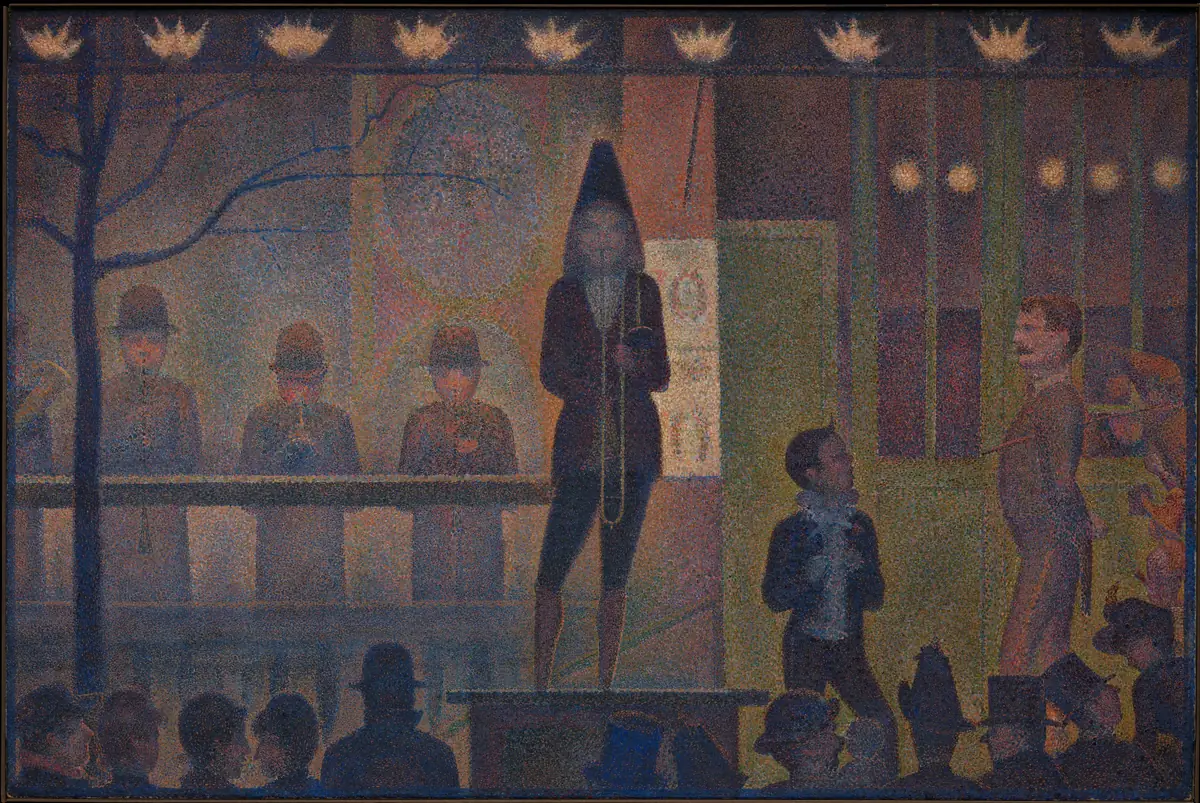
A lit platform in front of an audience: the gaze of others, which in social anxiety becomes hard to bear.
Georges Seurat, Circus Sideshow (Parade de cirque), 1887–88. Oil on canvas. The Metropolitan Museum of Art, New York. Public domain. Artwork record (external site)
In brief
Social anxiety disorder (social phobia) is an intense, persistent fear of being watched and judged negatively, which leads people to avoid social situations or endure them with great distress. It is not just shyness, and effective treatment exists. Individual cognitive behavioural therapy is the recommended first option for adults. Pedro Zuzarte, a psychiatrist in Lisbon, carries out the assessment in person or online.
What is social anxiety disorder?
It is an anxiety disorder in which the central fear is of being watched, judged or humiliated by others. The feared social situations almost always provoke anxiety, are avoided or endured with great distress, and the fear is out of proportion to the real risk. To speak of a disorder, this pattern usually lasts six months or more and causes significant distress or impairment.2
The difference from shyness lies not in the kind of feeling but in its intensity, persistence and impact. Research long ago stopped regarding it as mere shyness: it is one of the most common anxiety disorders, with an early onset and a tendency to persist.3 In the United States, about 13% of people are estimated to have it at some point in their lives.5
In some people the fear is limited to performance situations, such as speaking or performing in public; DSM-5-TR identifies this form with its own specifier.2 Social anxiety belongs to the group of anxiety disorders described on the Anxiety page.
What are the symptoms?
Symptoms appear before, during and after the feared situations. Feared situations include having a conversation or meeting new people, being observed, for example while eating or drinking, asking or answering questions, and speaking or performing in front of others.1,2
- Typical fears: looking anxious, blushing, sweating, trembling, going blank or seeming boring, and others noticing it.1
- Physical signs: blushing, sweating and trembling, and other signs of anxiety, such as palpitations or shortness of breath.1,5
- Self-focused attention: during the interaction, the person monitors themselves and forms a negative image of how they come across.1
- Safety behaviours: strategies to “not be noticed”, such as avoiding eye contact, rehearsing sentences or staying in a corner, which bring relief in the moment but keep the fear going.1
- Anticipation and replay: worry in the days before the situation and, afterwards, going over what went wrong.1
- Avoidance: turning down invitations, missing classes or meetings, choosing jobs with less contact.
When attacks are sudden and also occur outside social situations, panic attacks should be considered; when worry spreads to many everyday topics, generalised anxiety disorder.
How does it affect daily life?
It often starts early: in about half of people it begins by the age of 11 and, in about 80%, by the age of 20.3 Without treatment, it tends to be chronic and rarely goes away on its own.4
The impact shows in choices of study and career, in professional progress, in friendships and in romantic relationships. Social anxiety disorder is also a risk factor for depression and for problematic substance use.3 Alcohol or other drugs are often an attempt to ease anxiety in social situations, and this should not prevent the anxiety from being treated.1
Many people do not know that it is a recognised, treatable condition and experience it as a personal flaw; the fear of talking to strangers can itself delay asking for help.1 Anxiety disorders as a whole remain under-diagnosed and under-treated.6
When should I seek help?
It is worth seeking an assessment when:
- fear leads you to avoid important situations, such as classes, interviews, meetings or dates;
- anxiety before or after social situations takes up a lot of time and energy;
- you rely on alcohol, sedatives or other substances to be able to be with other people;
- persistent sadness, loss of interest or hopelessness appear, which may indicate depression;
- anxiety limits choices about study, work or personal life.
There is no need to wait until things become serious: the longer avoidance lasts, the more opportunities are lost.
How is it assessed?
The assessment considers fear, avoidance, distress and impact on daily life. It includes a detailed description of the situations that are feared and avoided, what the person fears might happen, the image they have of themselves in those situations, safety behaviours, worry before and after, and the use of medication, alcohol and other substances.1
Other conditions that often accompany social anxiety, or can resemble it, are also looked for: depression and other mood disorders, other anxiety disorders, alcohol and substance use, avoidant personality disorder, psychosis and autism spectrum conditions.1 Validated questionnaires can help measure severity and, later, progress.1
For some people, the first face-to-face contact is itself difficult; in such cases, guidelines allow starting by phone or online.1 Psychiatric consultations can take place in person in Lisbon or as an online consultation, in Portuguese, English or Spanish.
Which treatment has the best evidence?
In adults, the first recommended treatment is individual cognitive behavioural therapy (CBT) developed specifically for social anxiety.1 In a large network meta-analysis, individual CBT had the most consistent effects and was considered the best initial intervention.4 Depending on the model, it includes:1
- information about social anxiety and what keeps it going;
- exercises that show the effect of self-focused attention and safety behaviours, and training in externally focused attention;
- behavioural experiments to test negative predictions, and graduated exposure to feared situations;
- work on worry before and after situations and on core beliefs;
- relapse prevention.
Group CBT is also effective, but individual CBT has better results.1,4 For people who prefer another form of psychological help, CBT-based self-help supported by a professional is an alternative.1
Medication. For people who prefer drug treatment, the first option is an antidepressant from the selective serotonin reuptake inhibitor (SSRI) class.1,5 If there is no response, or side effects are not tolerated, a different SSRI or a serotonin–noradrenaline reuptake inhibitor (SNRI) can be used; at a later stage, UK guidelines allow a monoamine oxidase inhibitor, which requires dietary restrictions and care with other medicines.1 At the start there may be a temporary increase in anxiety, agitation or sleep problems. Treatment continues after improvement to prevent relapse, and stopping is always gradual and agreed with the doctor.1
When the response to one treatment is only partial, the other can be added: medication for people who have had CBT, or CBT for people taking medication.1 Guidelines do not recommend anticonvulsants, tricyclic antidepressants, benzodiazepines or antipsychotics as routine treatment.1 In children and young people, treatment is CBT focused on social anxiety, and medication is not routinely offered.1
For people who decline both CBT and medication, a short-term psychodynamic psychotherapy designed for social anxiety can be considered, with more limited effectiveness.1,4 The difference between the professionals involved is described in Psychiatrist or psychologist.
Which mistaken ideas delay help?
- “It’s just shyness.” Social anxiety disorder is distinguished by its intensity, persistence and impact, and it is a recognised condition.2,3
- “It will pass with time.” Without treatment, it tends to last for years.4
- “A drink helps me relax.” The relief is short-lived, and social anxiety is a risk factor for problematic use of alcohol and other substances.1,3
- “I just need to force myself.” Facing situations helps when it is planned, gradual and free of the safety behaviours that keep fear going; this is what is practised in CBT.1
- “It’s a flaw in me.” It is a condition with effective treatment, not a failing of character.1
UK guidelines do not recommend mindfulness-based interventions or supportive therapy as routine treatment, nor St John’s wort or other over-the-counter products for anxiety, nor botulinum toxin for excessive sweating.1 The most useful step is almost always to talk to a professional and start an evidence-based treatment.
Frequently asked questions
What is the difference between shyness and social anxiety?
Shyness is a common trait and usually does not stop a person from doing what they need to do. In social anxiety disorder, the fear of being watched and judged negatively is intense, out of proportion and persistent; it leads people to avoid situations or endure them with great distress, and it limits work, study or relationships. It is a recognised condition with its own diagnosis and treatment.
Can social anxiety be treated?
Yes. Individual cognitive behavioural therapy developed specifically for social anxiety is the recommended first treatment and has shown large effects in clinical trials. For people who do not want, or cannot access, psychotherapy, some antidepressants are an evidence-based alternative. Not everyone responds to the first treatment, but there are alternatives and combinations that can be considered in consultation.
Do I need to take medication?
Not necessarily. In adults, guidelines recommend starting with individual cognitive behavioural therapy. Medication, mainly an antidepressant from the SSRI class, is an option when the person prefers it, when psychotherapy is not accessible or when the response to therapy is only partial. In children and young people, medication is not routinely offered. The decision is made together, after the assessment.
Can the first consultation be an online consultation?
Yes. UK guidelines recognise that attending a first face-to-face appointment is difficult for some people with social anxiety, and allow the first contact to be made by phone or online. Psychiatric consultations can take place in person in Lisbon or online, in Portuguese, English or Spanish, and the format can be reviewed as care continues.
Can social anxiety start in childhood?
Yes, it often starts early: in about half of people it begins by the age of 11, and in most by the age of 20. In children it may show as avoiding school or group activities, speaking little in social situations, irritability or relying heavily on parents. The recommended treatment is cognitive behavioural therapy focused on social anxiety, involving parents when the child is young.
Key points
- Social anxiety disorder is an intense, persistent fear of being judged negatively by others, which leads to avoidance and limits personal and working life; it is not just shyness.
- Individual CBT designed for social anxiety is the first recommended treatment for adults; SSRI antidepressants are the main drug alternative.
- The assessment looks for depression, alcohol use and other associated conditions, and can start with an online consultation.
References
- National Institute for Health and Care Excellence. Social anxiety disorder: recognition, assessment and treatment (CG159). 2013. Source (external site)
- American Psychiatric Association. Diagnostic and Statistical Manual of Mental Disorders, Fifth Edition, Text Revision (DSM-5-TR). 2022. Source (external site)
- Stein MB, Stein DJ. Social anxiety disorder. Lancet. 2008;371(9618):1115–1125. doi:10.1016/S0140-6736(08)60488-2 PubMed (external site)
- Mayo-Wilson E, Dias S, Mavranezouli I, et al. Psychological and pharmacological interventions for social anxiety disorder in adults: a systematic review and network meta-analysis. Lancet Psychiatry. 2014;1(5):368–376. doi:10.1016/S2215-0366(14)70329-3 PubMed (external site)
- Szuhany KL, Simon NM. Anxiety disorders: a review. JAMA. 2022;328(24):2431–2445. doi:10.1001/jama.2022.22744 PubMed (external site)
- Bandelow B, Michaelis S. Epidemiology of anxiety disorders in the 21st century. Dialogues Clin Neurosci. 2015;17(3):327–335. doi:10.31887/DCNS.2015.17.3/bbandelow PubMed (external site)
A psychiatric assessment can be the first step.