Ketamine (also written cetamina or ketamina) is a single anaesthetic; esketamine is the S form of the molecule, authorised in the European Union as a nasal spray for treatment-resistant depression, «quetamina» is a Brazilian spelling, and quetiapine is a different medicine, an antipsychotic.
S formesketamine
R formarketamine
S formR form
Move the cursor over the figure, or drag it, to rotate it; with the keyboard, use the arrow keys.Drag the figure sideways to rotate it.
Fig. 1 The two forms of the ketamine molecule: S (esketamine) and R (arketamine), each the mirror image of the other.
In brief
The ketamine used in anaesthesia is an equal mixture of the S form (esketamine) and the R form (arketamine).
Arketamine, the R form on its own, is not authorised and is used only in clinical trials.
In treatment-resistant depression, ketamine is used outside its approved indications, off-label.
In Portugal, esketamine has been publicly funded for hospital use since 2025, for a restricted group.
Are ketamine, cetamina and ketamina the same?
Yes: cetamina is the Portuguese spelling and ketamina a variant close to the English ketamine; they name the same injectable general anaesthetic.
Read more
Yes. Ketamine is the English name; cetamina is the Portuguese spelling and ketamina a variant close to English. All three refer to the same medicine: an injectable general anaesthetic, on the World Health Organization's List of Essential Medicines since 1984.7
Outside anaesthesia, ketamine is studied in treatment-resistant depression, where controlled trials have shown a rapid antidepressant effect.8 What that research shows is summarised on the page about ketamine in treatment-resistant depression.
Is esketamine the same as ketamine?
Not exactly: ketamine is an equal mixture of the S and R forms, and esketamine is the S form alone.
As a nasal spray, authorised in the European Union since 2019 for adults with treatment-resistant depression, with an antidepressant.
Read more
Not exactly. The ketamine molecule has a chiral centre: a carbon atom bonded to four different groups. That is why it exists in two forms that are mirror images of each other, the S form and the R form (figure 1). The ketamine used in anaesthesia is a mixture of equal parts of both, known as a racemic mixture. Esketamine is the S form alone; arketamine, the R form alone.5,1
As a nasal spray, esketamine has been authorised in the European Union since 18 December 2019 for adults with treatment-resistant depression, always together with an SSRI or SNRI antidepressant. The spray is self-administered in an appropriate clinical setting, under the direct supervision of a healthcare professional.1,2 Since February 2021, the authorisation also covers a short-term treatment in psychiatric emergencies.9
What is the difference between ketamine, esketamine, arketamine, quetamina and quetiapine?
The five names, side by side.
What it is
Route
Status in Portugal
Ketamine (cetamina)
General anaesthetic: S and R forms
Injection
Authorisedoff-label in depression
Esketamine
S form, on its own
Nasal spray
Authorised EU 2019; NHS hospital use 2025, restricted group
Arketamine
R form, on its own
Trials only
Not authorised under investigation
Quetamina
Brazilian spelling of ketamine
As ketamine
Not a different medicine
Quetiapine
Antipsychotic, unrelated to ketamine
Oral
Authorised on prescription
See the full table
Status in Portugal
Authorised
Off-label use
Under investigation
A different medicine
Another spelling
Tap a name to highlight it in the table and in the figure.
Five similar names: what each one is, which form of the molecule it contains, how it is given, its status in Portugal and what it is indicated for.
Name
What it is
Molecule
Route
Status in Portugal
Indication
Ketaminecetamina, ketamina
General anaesthetic: a mixture of equal parts of the S and R forms.5
S and R
Injection (intravenous or intramuscular)
AuthorisedOff-label useAuthorised as an anaesthetic.7 In depression, used off-label.
Anaesthesia, sedation and analgesia.7 In treatment-resistant depression, off-label use only.
AuthorisedAuthorised in the European Union since 2019; publicly funded for hospital use in the Portuguese national health service since 2025, for a restricted group of patients.2,10
Treatment-resistant depression, with an antidepressant; short-term treatment in psychiatric emergencies.1,9
A different medicineAuthorisedAuthorised, on prescription.11
Schizophrenia and bipolar disorder; the prolonged-release form also as add-on treatment in major depression.11
Where is esketamine approved, and how is ketamine used?
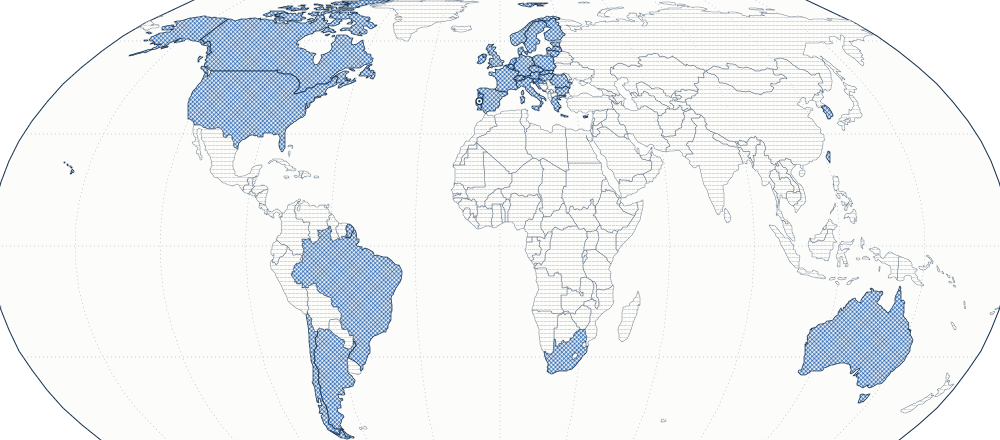
The map shows where esketamine nasal spray is approved for depression and, under the ketamine filter, where ketamine has an official status in depression. Each country has a card, with the sources in its details.
How many countries, by status
40Esketamine approvedcountries
1Ketamine fundedcountry
3Ketamine in clinical guidelinescountries and 1 region
1Ketamine documented off-label usecountry and 1 region
Esketamine approvals, 2019 to 2022
USA: 5 March 2019
European Union: 18 December 2019
Switzerland: 25 February 2020
Canada: 20 May 2020
South Korea: 23 June 2020
Brazil: 29 October 2020
United Kingdom: 1 January 2021
Australia: 9 March 2021
Chile: 8 November 2021
Taiwan: 13 January 2022
South Africa: 6 April 2022
No date confirmed in the register: Argentina, Norway, Singapore.
Show on the map
Approved
No confirmed official status
Funded
In clinical guidelines
No confirmed official status
Substance
Portugal
2019esketamine, via the EU
Esketamine approved
See detailsClose details
Esketamine approved through the EU in 2019; funded in public hospitals since 2025, restricted group.
Esketamine · approved
Authorised in the European Union for treatment-resistant depression in adults, together with an antidepressant. Public funding for hospital use was approved by INFARMED in 2025, for a narrower indication.
Since 18 December 2019
Sources
EMA (external site): European public assessment report for esketamine nasal spray; authorised in the EU since 18 December 2019. Checked on 12 November 2026
INFARMED (external site): Public funding assessment report for esketamine in treatment-resistant depression (approved 7 May 2025). Checked on 12 November 2026
European Union27 countries
2019esketamine
Esketamine approved
See detailsClose details
Centralised authorisation of esketamine nasal spray, with an antidepressant, in treatment-resistant depression.
Esketamine · approved
Centralised European Commission authorisation: esketamine nasal spray, together with an antidepressant, for adults with treatment-resistant depression.
Since 18 December 2019
Sources
EMA (external site): European public assessment report for esketamine nasal spray; authorised in the EU since 18 December 2019. Checked on 12 November 2026
United States (federal)
2019esketamine
Esketamine approved
Ketamine in clinical guidelines
See detailsClose details
Esketamine FDA-approved (2019); veterans' guideline: ketamine for augmentation, weak recommendation in favour.
Esketamine · approved
Approved by the FDA for treatment-resistant depression in adults (2019), for depressive symptoms with acute suicidal ideation (2020) and, since January 2025, also as monotherapy in treatment-resistant depression. Dispensing restricted to certified settings.
Since 5 March 2019
Ketamine · in clinical guidelines
Federal clinical practice guideline of the Departments of Veterans Affairs and Defense for major depressive disorder (version 4.0, February 2022): suggests ketamine or esketamine as an augmentation option after no response to several adequate pharmacological trials (weak for) and suggests against both as initial treatment. It applies to veterans' and military health services.
Sources
FDA (external site): Drugs@FDA, application 211243 (esketamine nasal spray): approved 5 March 2019, with later supplements. Checked on 12 November 2026
FDA (external site): Esketamine prescribing information revised January 2025 (monotherapy in treatment-resistant depression). Checked on 12 November 2026
VA / DoD (EUA) (external site): Clinical practice guideline for the management of major depressive disorder, version 4.0 (February 2022), recommendations 12 and 19. Checked on 12 November 2026
Canada
2020esketamine
Esketamine approved
See detailsClose details
Esketamine authorised by Health Canada in 2020 for treatment-resistant major depression.
Esketamine · approved
Authorised by Health Canada on 20 May 2020 for treatment-resistant major depressive disorder in adults, together with an SSRI or SNRI. Since 2 September 2021 also as short-term treatment, with an oral antidepressant, for the rapid reduction of symptoms in major depressive disorder that, in clinical judgement, requires urgent psychiatric care. In December 2020 the national health technology assessment agency recommended that it not be reimbursed.
Since 20 May 2020
Sources
Health Canada (external site): Regulatory Decision Summary RDS00738: esketamine nasal spray in treatment-resistant major depressive disorder (decision of 20 May 2020). Checked on 12 November 2026
Health Canada (external site): Regulatory Decision Summary RDS00895: indication extended to major depressive disorder requiring urgent psychiatric care (decision of 2 September 2021). Checked on 12 November 2026
Canada's Drug Agency (antiga CADTH) (external site): Final expert-committee recommendation SR0621: esketamine should not be reimbursed for major depressive disorder in adults (December 2020). Checked on 12 November 2026
United Kingdom
2021esketamine, British licence
Esketamine approved
See detailsClose details
Covered by the 2019 EU authorisation; its own British licence since 2021.
Esketamine · approved
While in the European Union, the United Kingdom was covered by the EU authorisation of 18 December 2019. On 1 January 2021 the MHRA converted it into a Great Britain authorisation; in Northern Ireland the EU authorisation applied until 31 December 2024 and, since 2025, the British one covers the whole United Kingdom. Indications: treatment-resistant depression in adults, and acute short-term treatment of major depressive episodes that constitute a psychiatric emergency. In England, NICE does not recommend it for treatment-resistant depression (December 2022); in Scotland, the SMC accepted it for treatment-resistant depression (September 2020) but not for the psychiatric emergency (November 2022).
Since 1 January 2021
Sources
EMA (external site): European public assessment report for esketamine nasal spray; authorised in the EU since 18 December 2019. Checked on 12 November 2026
MHRA (gov.uk) (external site): Great Britain marketing authorisations for centrally authorised products: list of PLGB numbers (esketamine 28 mg nasal spray, PLGB 00242/0648). Checked on 12 November 2026
MHRA (gov.uk) (external site): Guidance: conversion of centrally authorised products into UK marketing authorisations on 1 January 2021. Checked on 12 November 2026
NICE (external site): Technology appraisal TA854: esketamine nasal spray for treatment-resistant depression, not recommended (14 December 2022). Checked on 12 November 2026
Scottish Medicines Consortium (external site): Advice SMC2258: esketamine accepted for use in NHSScotland for treatment-resistant depression (7 September 2020). Checked on 12 November 2026
Scottish Medicines Consortium (external site): Advice SMC2539: esketamine not recommended as acute treatment in a psychiatric emergency (7 November 2022). Checked on 12 November 2026
Switzerland
2020esketamine
Esketamine approved
See detailsClose details
Esketamine authorised by Swissmedic in 2020; extended to psychiatric emergencies in 2021.
Esketamine · approved
Authorised by Swissmedic on 25 February 2020 for treatment-resistant depression in adults, with an oral antidepressant. On 27 August 2021 the indication was extended to the acute short-term treatment of severe depressive episodes without psychotic symptoms that constitute a psychiatric emergency.
Since 25 February 2020
Sources
Swissmedic (external site): Medicines with new active substances: esketamine nasal spray, authorisation no. 67103 of 25 February 2020. Checked on 12 November 2026
Swissmedic (external site): Public summary of the assessment report (SwissPAR): indication extended on 27 August 2021 (severe depressive episodes, psychiatric emergency). Checked on 12 November 2026
Norway
2025ketamine, funded
Esketamine approved
Ketamine funded
Ketamine documented off-label use
See detailsClose details
Esketamine through the EU authorisation; intravenous ketamine publicly funded since 2025.
Esketamine · approved
As a European Economic Area member, Norway follows the EU authorisation of December 2019; the Norwegian Medicines Agency's assessment quotes the Norwegian indication: treatment-resistant depression in adults, with an SSRI or SNRI. The public specialist health service decided not to introduce it for treatment-resistant depression (April and October 2021; October 2022) and, in 2024, that it should not be used for the psychiatric emergency.
Ketamine · funded
On 25 August 2025 the decision forum of the four regional health authorities decided that ketamine may be used for treatment-resistant depression in the public specialist health service, for now in hospital or a district psychiatric centre, with follow-up through a registry or clinical trial until more is known about long-term effects. The decision assumes the same price level and will be reviewed by the end of 2028. The method assessed was intravenous ketamine.
Since 25 August 2025
Ketamine · documented off-label use
The decision of 25 August 2025 requires patients to be told that ketamine for treatment-resistant depression is given outside the approved indication («utenfor godkjent indikasjon»), why, and what that implies.
Sources
EMA (external site): European public assessment report for esketamine nasal spray; authorised in the EU since 18 December 2019. Checked on 12 November 2026
Statens legemiddelverk (Noruega) (external site): Rapid assessment ID2019_116 of esketamine in treatment-resistant depression, quoting the Norwegian indication (November 2020). Checked on 12 November 2026
Nye metoder (Noruega) (external site): Method ID2019_116: esketamine for treatment-resistant depression, not introduced (decisions of 2021 and 18 October 2022). Checked on 12 November 2026
Nye metoder (Noruega) (external site): Method ID2020_042: esketamine for a psychiatric emergency, not to be used (2024). Checked on 12 November 2026
Beslutningsforum for nye metoder (Noruega) (external site): Approved minutes of the meeting of 25 August 2025, case 119-2025 (ID2022_018): ketamine for treatment-resistant depression. Checked on 12 November 2026
Nye metoder (Noruega) (external site): Method ID2022_018: intravenous ketamine for treatment-resistant depression (decision taken). Checked on 12 November 2026
Australia
2021esketamine
Esketamine approved
See detailsClose details
Esketamine registered by the TGA in 2021; funded by the public PBS scheme since 2025.
Esketamine · approved
Registered by the TGA on 9 March 2021 for treatment-resistant depression in adults, started together with a newly initiated oral antidepressant. Funded by the public medicines scheme (PBS) for treatment-resistant depression since 1 May 2025.
Since 9 March 2021
Sources
TGA (external site): ARTG 311827 public summary (esketamine nasal spray): start date 9 March 2021, with the indication. Checked on 12 November 2026
PBS (Governo da Austrália) (external site): Medicine status: esketamine for treatment-resistant depression, recommended in December 2024 and listed on the PBS on 1 May 2025. Checked on 12 November 2026
Brazil
2020esketamine
Esketamine approved
See detailsClose details
Esketamine registered by ANVISA in October 2020 for treatment-resistant major depression.
Esketamine · approved
Registered by ANVISA (Resolution RE 4,413 of 29 October 2020, published in the Official Gazette on 3 November 2020) for treatment-resistant major depressive disorder in adults, with oral antidepressants, and for the rapid reduction of depressive symptoms in adults with major depressive disorder and acute suicidal behaviour or ideation.
Since 29 October 2020
Sources
ANVISA / Diário Oficial da União (external site): Resolution RE 4,413 of 29 October 2020: registration of esketamine nasal spray as a new medicine. Checked on 12 November 2026
ANVISA (external site): New medicines and indications: registration of esketamine hydrochloride and approved indications (November 2020). Checked on 12 November 2026
Argentina
2020esketamine, on the August list
Esketamine approved
See detailsClose details
Esketamine authorised by ANMAT; already on its list of authorisations in August 2020.
Esketamine · approved
Authorised by ANMAT (certificate 59,173), which already listed it among its August 2020 authorisations, for treatment-resistant depression in adults and for depressive symptoms in adults with major depressive disorder and acute suicidal ideation or behaviour, always with an oral antidepressant. The original registration date was not found in a primary source.
Sources
ANMAT (external site): Disposition 3031/2021: new approved leaflet for esketamine nasal spray (certificate 59,173), with the indications. Checked on 12 November 2026
ANMAT (external site): List of authorisations, August 2020 (certificate 59,173, esketamine 28 mg nasal spray). Checked on 12 November 2026
Chile
2021esketamine
Esketamine approved
See detailsClose details
Esketamine registered by the Public Health Institute in November 2021.
Esketamine · approved
Registered by Chile's Public Health Institute on 8 November 2021 for treatment-resistant depression in adults, with an oral antidepressant. The current record also lists use as monotherapy.
Since 8 November 2021
Sources
Instituto de Salud Pública de Chile (external site): Registry record F-26406/26 (esketamine nasal spray): registered on 8 November 2021, with the current indication. The page only opens after a search in the registry. Checked on 12 November 2026
Instituto de Salud Pública de Chile (external site): Approved professional information leaflet (registration F-26406/21): treatment-resistant depression in adults. Checked on 12 November 2026
South Korea
2020esketamine
Esketamine approved
See detailsClose details
Esketamine approved by the Ministry of Food and Drug Safety in June 2020.
Esketamine · approved
Approved by the Ministry of Food and Drug Safety on 23 June 2020. The current record lists treatment-resistant major depressive disorder in adults and rapid improvement of depressive symptoms in adults with major depressive disorder and acute suicidal ideation or behaviour, always with an oral antidepressant.
Since 23 June 2020
Sources
MFDS (Coreia do Sul) (external site): Medicine record 202004585 (esketamine nasal spray): approved on 23 June 2020, with indications. Checked on 12 November 2026
Taiwan
2022esketamine
Esketamine approved
See detailsClose details
Esketamine licensed by Taiwan's food and drug agency in January 2022.
Esketamine · approved
Licence issued by Taiwan's Food and Drug Administration on 13 January 2022 for treatment-resistant depression in adults and, with an oral antidepressant, for depressive symptoms in adults with major depressive disorder and acute suicidal ideation or behaviour.
Since 13 January 2022
Sources
TFDA (Taiwan) (external site): Import licence no. 028215 (esketamine nasal spray): issued on 13 January 2022, with indications. Checked on 12 November 2026
Singapore
2020esketamine
Esketamine approved
See detailsClose details
Esketamine approved in October 2020; listed in the Ministry of Health national formulary.
Esketamine · approved
The Ministry of Health states that the Health Sciences Authority approved it in October 2020. The Ministry's national drug formulary lists treatment-resistant depression in adults, as monotherapy or with an SSRI or SNRI, and acute short-term treatment, with an oral antidepressant, of moderate to severe major depressive episodes that constitute a psychiatric emergency.
Ministério da Saúde de Singapura (external site): Parliamentary reply of 5 February 2025: nasal spray approved in October 2020 by the Health Sciences Authority. Checked on 12 November 2026
South Africa
2022esketamine
Esketamine approved
See detailsClose details
Esketamine registered by SAHPRA in April 2022 for treatment-resistant depression.
Esketamine · approved
Registered by SAHPRA (no. 53/1.2/0732), first authorised on 6 April 2022, for treatment-resistant depression in adults, with an SSRI or SNRI.
Since 6 April 2022
Sources
SAHPRA (external site): Approved professional information for esketamine nasal spray: registration no. 53/1.2/0732, first authorised on 6 April 2022. Checked on 12 November 2026
Germany
2022ketamine, restrictive guideline
Ketamine in clinical guidelines
See detailsClose details
Restrictive national guideline: intravenous ketamine only in inpatient psychiatry, case by case.
Ketamine · in clinical guidelines
The national care guideline for unipolar depression (version 3.2) is restrictive: intravenous ketamine, used off-label, shall not be used outside inpatient psychiatric care (strong recommendation against). In inpatient care it is accepted only case by case, in the most severe resistant forms, especially with acute suicidality; the guideline makes no recommendation in favour.
Since 29 September 2022
Sources
BÄK, KBV e AWMF (programa NVL) (external site): National care guideline for unipolar depression, version 3.2, recommendation 7-25 and section 12.3.6 (intravenous ketamine). Checked on 12 November 2026
Malaysia
2019ketamine, favourable guideline
Ketamine in clinical guidelines
See detailsClose details
Favourable Ministry of Health guideline: short-term intravenous ketamine, up to two weeks.
Ketamine · in clinical guidelines
Ministry of Health clinical practice guideline for major depressive disorder (2nd edition, 2019): intravenous ketamine may be considered short-term (up to two weeks) in the acute phase of moderate to severe major depressive disorder.
Sources
Ministério da Saúde da Malásia (MaHTAS) (external site): Clinical practice guideline for major depressive disorder, 2nd edition (2019), recommendation 9 (intravenous ketamine). Checked on 12 November 2026
Quebec (Canada)
2026ketamine, favourable guidance
Ketamine in clinical guidelines
Ketamine documented off-label use
See detailsClose details
Favourable public guidance, with conditions: INESSS frames off-label use of intravenous ketamine.
Ketamine · in clinical guidelines
INESSS, a Quebec public body, published clinical tools, including a prescription template, for intravenous ketamine as an acute adjunctive treatment of depression refractory to optimised usual therapies in adults. They were announced on 2 June 2026, following an assessment published in May 2025.
Ketamine · documented off-label use
INESSS states that these tools are meant to frame the off-label use («usage hors indication») of intravenous ketamine in refractory depression (bulletin of 2 June 2026).
Sources
INESSS (Quebeque) (external site): Bulletin of 2 June 2026: intravenous ketamine as acute adjunctive treatment of refractory depression in adults, optimal-use conditions and clinical tools. Checked on 12 November 2026
The situation of other substances under investigation, such as psilocybin and MDMA, is on KETAMED's Psychedelics worldwide page (external site).
How many ketamine sessions are needed for depression?
There is no fixed number. The most studied schedules range from two sessions a week to one session a week, for a few weeks.12,13 The appropriate schedule is decided case by case, after a psychiatric assessment.
Which medicines contain ketamine?
In Portugal there are two medicines containing ketamine: ketamine as a solution for injection, authorised for anaesthesia, and esketamine as a nasal spray, authorised for treatment-resistant depression.
Read more
In Portugal, ketamine is available as a solution for injection, authorised for anaesthesia. In treatment-resistant depression and other clinical conditions, it is used outside its approved indications (off-label use), which always requires a prior psychiatric assessment. Esketamine is available as a nasal spray, authorised for treatment-resistant depression, and is publicly funded for hospital use in the Portuguese national health service for a restricted group of patients.10
Is ketamine legal in Portugal?
Yes: ketamine is an authorised medicine, used by doctors in a clinical setting; in depression, its use is off-label.
Read more
Ketamine is an authorised medicine, used by doctors in a clinical setting.7 Its use in depression is off-label, that is, outside the conditions approved in its summary of product characteristics (SmPC): it is an individual clinical decision, for which the prescribing doctor is responsible, that should rest on scientific evidence and be taken with informed consent.14
European Medicines Agency. Esketamine nasal spray: summary of product characteristics (sections 4.1 to 5.1). Source (external site)
European Medicines Agency. Esketamine nasal spray: European public assessment report (EPAR, EMEA/H/C/004535); marketing authorisation valid throughout the EU since 18 December 2019. Source (external site)
Brazilian Academy of Letters. Vocabulário Ortográfico da Língua Portuguesa (VOLP): «quetamina», noun. Accessed 12 November 2026. Source (external site)
World Health Organization Collaborating Centre for Drug Statistics Methodology. ATC classification: N05AH04, quetiapine (antipsychotics). Source (external site)
National Center for Biotechnology Information. PubChem: esketamine, (2S)-2-(2-chlorophenyl)-2-(methylamino)cyclohexan-1-one, CID 182137; arketamine, the (2R) form, CID 644025; ketamine (racemic mixture), CID 3821. Formula C13H16ClNO. Source (external site)
Johnston JN, Henter ID, Zarate CA Jr. The antidepressant actions of ketamine and its enantiomers. Pharmacol Ther. 2023;246:108431. doi:10.1016/j.pharmthera.2023.108431 DOI (external site)
World Health Organization. Electronic Essential Medicines List: ketamine (injectable general anaesthetic; on the list since 1984). Source (external site)
Zarate CA Jr, Singh JB, Carlson PJ, et al. A randomized trial of an N-methyl-D-aspartate antagonist in treatment-resistant major depression. Arch Gen Psychiatry. 2006;63(8):856–864. doi:10.1001/archpsyc.63.8.856 PubMed (external site)
European Medicines Agency. Esketamine nasal spray: procedural steps taken after authorisation (extension of indication, European Commission decision of 4 February 2021). Source (external site)
Infarmed (Portuguese medicines authority). Public funding assessment report: esketamine (nasal spray) in treatment-resistant depression. Approval decision of 7 May 2025; report of 12 May 2025. Source (external site)
European Medicines Agency. Quetiapine: Article 30 referral procedure (EMEA/H/A-30/1362), Annex III, EU-harmonised summary of product characteristics, section 4.1 (European Commission decision of 6 August 2014; Portuguese version). Source (external site)
Singh JB, Fedgchin M, Daly EJ, et al. A double-blind, randomized, placebo-controlled, dose-frequency study of intravenous ketamine in patients with treatment-resistant depression. Am J Psychiatry. 2016;173(8):816–826. doi:10.1176/appi.ajp.2016.16010037 PubMed (external site)
Gallagher B, Foley M, Slattery CM, et al. Ketamine as an adjunctive therapy for major depression: a randomised controlled pragmatic pilot trial (Karma-Dep Trial). HRB Open Res. 2022;3:90. doi:10.12688/hrbopenres.13182.2 PubMed (external site)
National Committee for Pharmacy and Therapeutics, Infarmed. Utilização de medicamentos em regime off-label [Off-label use of medicines]. Guidance, March 2025 (in Portuguese). Source (external site)
Written and reviewed by Pedro Zuzarte, psychiatrist · Last reviewed:
In Portugal, ketamine is approved as an anaesthetic; in depression its use is off-label. Psychedelic therapy and the psychotherapies that accompany it remain under research, and further studies are still needed before a formal clinical indication. Any decision is individual, made after psychiatric assessment and with written informed consent.
Educational health information, prepared taking into account the position of the College of Psychiatry of the Portuguese Medical Association on the use of psychedelics (CEP-2023-R-02). It is not advertising for medicines nor a treatment recommendation, and it does not replace a medical consultation.